If you have a degree, your certificate is likely to be in a drawer at home,
or in a folder of old paperwork. You looked at it properly on the day it
arrived and probably not since.
That sheet of paper stands for three years of work, and your family came to
watch you collect it. Your name is printed in the middle.
Take the name off and the page would fit anybody.
One of our cases at Verifile was about the name on a certificate. A property
firm had offered a candidate a job as a client onboarding analyst, and asked
us to verify the law degree on her application.
We'll call her Rachel Marian Doyle*.
A routine verification
Rachel had declared a Bachelor of Laws (LLB) from Southampton Solent
University, awarded more than fifteen years earlier. The verification began
the way most of them do. The university needed her signed consent, we asked
her for it, and she returned it promptly.
Before the university would confirm anything, it wanted to see the
certificate itself. That request is routine and does not mean anyone is
suspicious. A degree awarded that long ago may not be in a university's
electronic records, and somebody has to go and check the paper records.
Rachel sent her certificate over and we passed it on.
The university did not confirm the degree. Instead, it asked us a question.
The certificate said Marion Doyle, but our request was for Rachel Marian
Doyle. Had Rachel been awarded the degree under the name Marion Doyle?
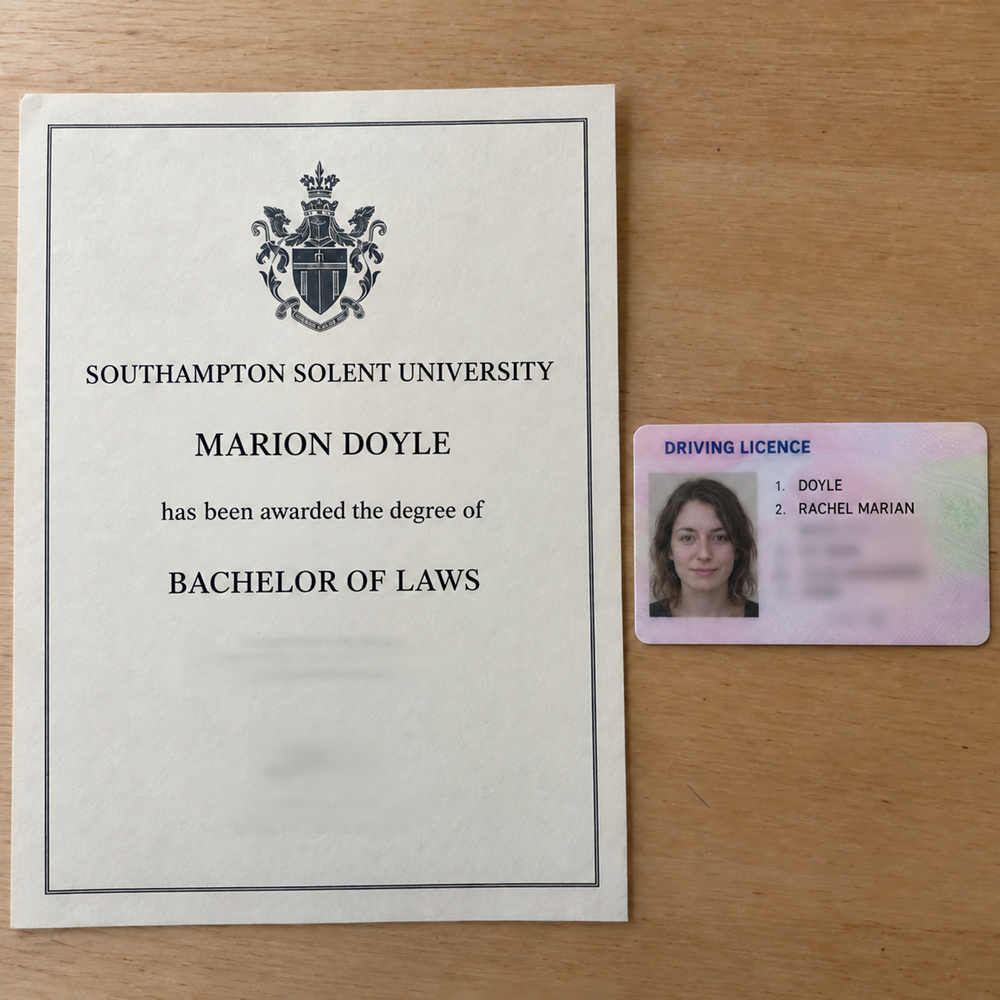
A careful reader would have found nothing wrong with that certificate,
because there was nothing wrong with it. The crest, the wording, the
signatures and the year were all exactly what they should be. Only the name
did not fit, and the name was the one thing Rachel had an explanation for.
The most ordinary explanation in the world
Rachel told us she had been known as Marion Doyle while she was studying.
Taken on its own, a different name at university is not a red flag and it
should not be treated as one. Plenty of people go by a middle name rather
than a first one. Spellings drift, families use one form while the paperwork
uses another, and the name somebody used at nineteen is often not the name
on their passport at forty. We see this constantly, and almost every time
there is nothing behind it.
What is harder to explain is being formally enrolled under that name. A
university registers a student under the name on their documents, not the
name their friends use. And the name on the certificate was not simply her
middle name. It was her middle name spelt with one different letter.
Rachel's passport does not carry the middle name at all. Her driving licence
carries it as Marian.
Then Rachel did something candidates in her position rarely do. She sent a
second document to support the first, a university student card in the name
on the certificate, with Rachel's photograph on it.
The card has a thin red box printed on it for the photograph. The photograph
does not sit inside the box. It crosses the printed line on two sides.
We noted where the photograph sat and carried on, because a photograph in
the wrong place is something you can see and not something you can prove.
But the second document did keep the case open. A document sent to prove
another document proves nothing until the university that holds the record
confirms it.
The date of birth
A university verification is usually finished in days. This one had been
running for almost a week and had produced a new question at every step, and
by this point it had stopped feeling routine.
The university replied once more. Before it would say anything about the
degree, it wanted the date of birth of the person who had earned it.
We took the date from Rachel's passport and her driving licence, which both
show the same date, and sent it that afternoon.
The answer arrived the same day.
“Hello - unfortunately, we do not have a candidate on our records with the
name '[Marion Doyle]' with the date of birth [removed].”
Whose certificate was it
A forged certificate would have carried Rachel's own name. Carrying the
right name is the entire point of forging a certificate, and a forger who
prints the wrong name has created a problem where none existed.
Our team could see only one explanation. The certificate is real, it records
a real degree, and the woman who earned it is not Rachel.
The student card needs explaining too. Rachel did not only hold that woman's
degree certificate. She also held that woman's student card, from the same
university and the same year as the certificate. A student card does not get
passed around. It stays with the person it was issued to, or it is thrown
away.
Nobody holds a stranger's student card. People who share a house hold each
other's.
They also share a surname.
We have seen family names used this way before, near-identical names inside
one family, and a relative's certificate is the explanation that fits the
facts. Nobody established it, and nobody asked the university to.
One question is still open. Somewhere there is a woman who earned that law
degree, and either she handed over her certificate and her student card, or
she has no idea that any of this happened.
The part that stays with you
Look again at what Rachel did after the university's first question.
She was asked to explain the name, and she explained it. She was asked to
prove the explanation, and she found a document and sent it in. She was
asked for a date of birth, and she gave the real one, from her real passport,
for the university to check.
The university pushed back twice, with a sharper question each time, and
Rachel kept going.
In the end, the answer was in documents we already had. Rachel's passport
and driving licence, which we verified at the start, carried her date of
birth, and the university had no Marion Doyle with that date on its records.
Names and certain details have been changed for confidentiality.
Verification Chronicles is our record of the cases that come through our
verification team, real files, names changed, told as they happened. We
publish them because the next employer to see one of these should
recognise it faster than we did.
Read more episodes →